
What Size Furnace Do I Need?
Getting your furnace size right is one of the most important decisions you'll make for your home's comfort. It's not just about keeping the cold out; it's about creating a space where your family feels genuinely at ease, no matter how low the temperature drops outside.
Size matters more than most homeowners realize. A furnace that's too small will run almost constantly trying to reach your desired temperature, driving up energy bills and wearing itself out faster than it should. On the other end, a furnace that's too large will short-cycle, meaning it fires up, overheats the space quickly, then shuts off before completing a full heating cycle. The result is inconsistent temperatures, excess humidity fluctuation, and unnecessary mechanical stress on the system.
Getting the right fit from the start protects your investment and, more importantly, keeps your home feeling the way it should.
Basic Guidelines for Determining Furnace Size
Square footage is a starting point, but it's only one piece of the picture. HVAC professionals look at a combination of factors when determining the right furnace size for your home, including climate, your home's layout, insulation quality, ceiling height, window placement, and floor materials. For example, a well-insulated home in a moderate climate may need a smaller furnace than the same-sized home in a colder climate.
These numbers are a general reference point. A proper load calculation by a certified professional is the only way to know for certain what your home truly needs.
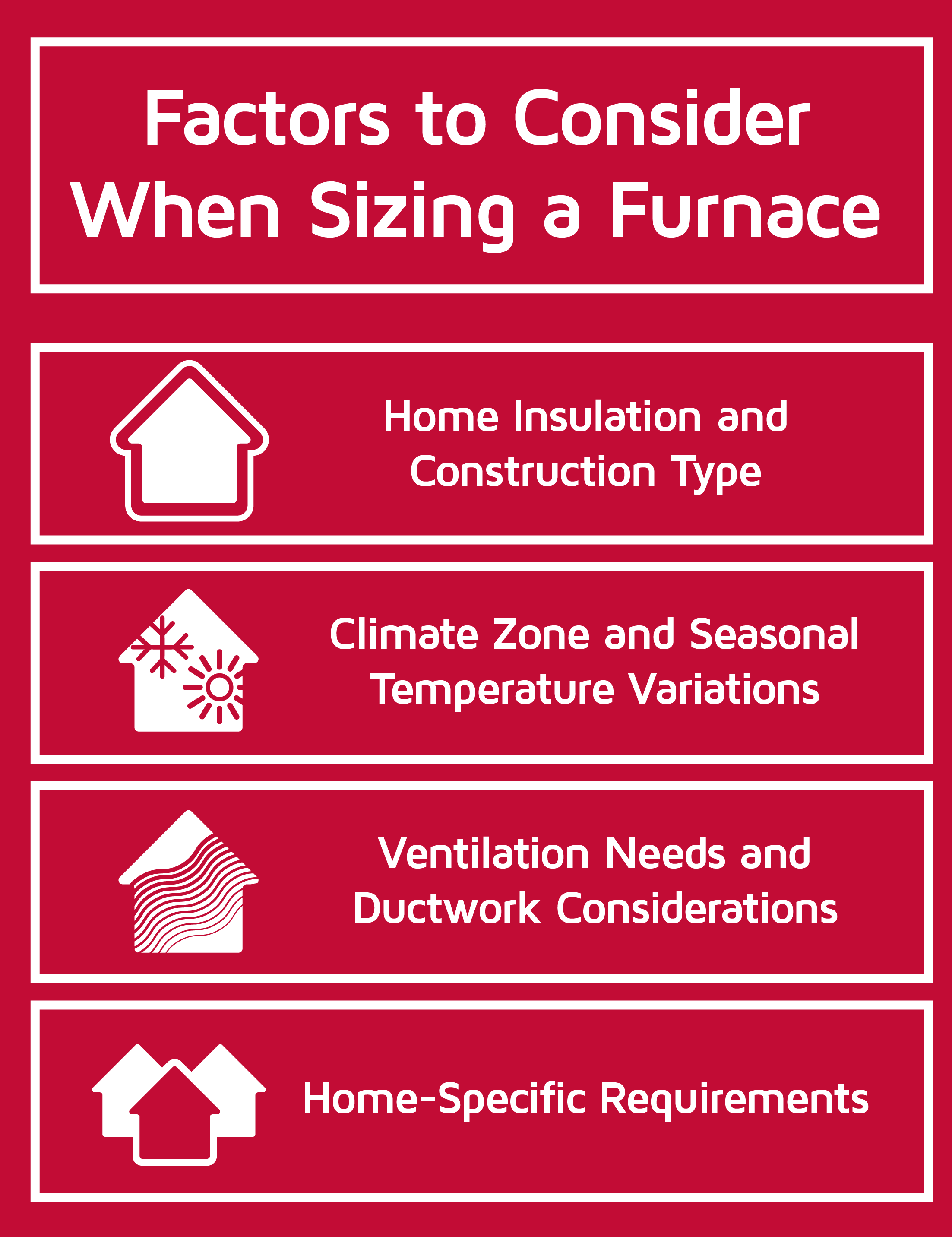
Factors to Consider When Sizing a Furnace
Home Insulation and Construction Type
Home insulation is your home's first line of defense against heat loss. A well-insulated home retains heat longer, so your furnace doesn't have to work as hard. Homes with older insulation, gaps around windows, or uninsulated walls lose heat more quickly, increasing the required heating capacity.
Climate Zone and Seasonal Temperature Variations
Where you live has a direct impact on how hard your furnace has to work. Homes in colder climates need higher-capacity systems to maintain consistent comfort throughout the season. This is one of the reasons a one-size-fits-all approach simply doesn't work for furnace sizing.
Ventilation Needs and Ductwork Considerations
Your ductwork plays a significant role in how effectively heat moves through your home. Leaky or undersized ducts can undermine even a perfectly sized furnace, reducing efficiency and leaving some rooms colder than others. A professional assessment includes a review of your existing ductwork to ensure the system as a whole is set up to perform.
Home-Specific Requirements
Ceiling heights, window placements, and floor materials all influence how warm or cool a home stays. High ceilings mean more air volume to heat. Large windows, especially older single-pane ones, allow more heat to escape. These details matter when determining the right furnace size, and they're exactly the kind of specifics a trained HVAC professional accounts for during a load calculation.
How Are Furnaces Rated and Measured?
Two furnaces can have the same heating capacity but perform very differently in terms of energy efficiency. Understanding how furnaces are rated helps you make a more informed choice and have a more productive conversation with your heating specialist.
BTU Ratings: Measuring Heating Output
A BTU (British Thermal Units) rating is the standard measure of a furnace's heating output per hour. While a higher BTU rating means more heat output, it may not be the right fit for your home for multiple reasons, including house size and climate. More isn't always better; it has to be right.
AFUE Ratings: Measuring Efficiency
AFUE (Annual Fuel Utilization Efficiency) tells you how effectively a furnace converts fuel into heat. An AFUE rating of 95% means 95 percent of the fuel becomes heat, with only 5% lost in the process. Higher AFUE ratings translate to lower heating costs and more consistent comfort over time.
High-Efficiency vs. Standard Furnaces
Not all furnaces convert fuel to heat at the same rate, and that difference is where efficiency really comes into play. Standard furnaces typically operate at around 80% AFUE. High-efficiency furnaces, on the other hand, operate at 90% AFUE or higher, with some models like Lennox’s SLP99VK reaching up to 99% AFUE, making it the most efficient furnace in the industry. At that level, nearly all of the fuel being used is actively working to warm your home. The practical difference between an 80% and a 99% AFUE furnace is significant over the course of a full heating season, making AFUE an important number to understand before making a purchase decision.
ENERGY STAR® Certification and Long-Term Savings
ENERGY STAR® is a program run by the U.S. Environmental Protection Agency (EPA) that identifies products meeting strict energy performance standards set by the federal government. A furnace carrying the ENERGY STAR® label has been independently verified to meet those standards, giving homeowners a reliable way to identify equipment that has been tested and certified for energy performance.
The Risks of Choosing the Wrong Furnace Size
Oversized Furnace
An oversized furnace can heat your space too quickly, triggering short cycling, where the system turns on and off in rapid succession. This leads to uneven temperatures, increased mechanical wear, a shorter system lifespan, and higher long-term costs.
Undersized Furnace
An undersized furnace never quite catches up. It runs continuously to meet demand, wastes energy, wears out rapidly, and leaves your home vulnerable during the coldest stretches of the season. Continuous overexertion can ultimately lead to premature equipment failure.
Why Professional Consultation Is Essential for Furnace Sizing?
Furnace sizing isn't a guessing game. A certified Lennox dealer brings the expertise needed to perform a precise load calculation, factoring in every variable specific to your home.
Professional consultation delivers:
Accurate Assessment: A trained specialist evaluates your square footage, insulation, climate zone, ceiling height, ductwork, and more to determine the exact heating capacity your home requires.
Proper Installation: Correct sizing is only half the equation. Expert installation ensures your system operates at peak efficiency from day one, preventing the common errors that compromise long-term performance.
Ongoing Support: From burner checks to vent inspections and duct evaluations, a Lennox dealer provides the kind of tailored service that keeps your system running reliably season after season.
Some signs it's time to call in a professional:
Your current system runs constantly without reaching your set temperature
Certain rooms feel noticeably colder than others
Your energy bills have climbed without a clear explanation
These are signals that your furnace may not be properly sized for your home.
Choosing the right HVAC professional means looking for a certified dealer with demonstrated experience and a commitment to doing the job correctly the first time. A Lennox dealer brings all of that, plus access to a full line of high-efficiency systems designed to deliver lasting comfort.
Get it Right, the First Time
Getting furnace sizing right is the foundation of a comfortable, efficient home. Every detail, from your insulation to your home layout to your local climate, plays a role in determining the correct system for your space. A Lennox dealer has the tools, training, and expertise to take the guesswork out of the equation entirely, ensuring proper sizing, installation, and maintenance so your system is built to last. Connect with a Lennox dealer today to get started.
We’re here to help make home comfort solutions a little clearer and a lot less stressful.
No Worries. It’s a Lennox.™